Content Strategy & AI Innovation Case Study:
Building a Buyer Intelligence System
bswift already held valuable buyer intelligence across prospect conversations, client meetings, RFPs, reviews, case studies, campaign data, and leadership perspectives. But that knowledge lived in different systems and was used inconsistently. I set out to turn what bswift already knew into persistent strategic context, connecting a deeper understanding of our buyers with our brand narrative and building a way to test marketing content against that understanding before publication.
The Issue
Most marketing teams learn whether a message resonates after they publish it. I wanted bswift to learn earlier.
The company already held valuable buyer intelligence: prospect conversations, client meetings, RFPs, reviews, case studies, campaign data, win/loss findings, and leadership perspective. But those signals lived in different systems and were used inconsistently. An internal Loop Marketing model identified the same problem directly: bswift could hear what buyers said, see what they did, and measure what worked, but the knowledge remained divided across Chorus, Salesforce, HubSpot, Win/Loss, and other sources.
That fragmentation created a practical content problem. Before a campaign, messaging matrix, executive byline, or article launched, quality depended heavily on who was in the room and what they happened to remember. Audience context had to be reconstructed for each project. AI could accelerate production, but without strong context, it could also accelerate generic language, unsupported claims, and messaging that sounded polished without sounding true.
My opportunity was not simply to write a better persona or create a better prompt. It was to turn what bswift already knew into persistent strategic context, and then put that context inside the workflow where marketing decisions were being made
The Plan
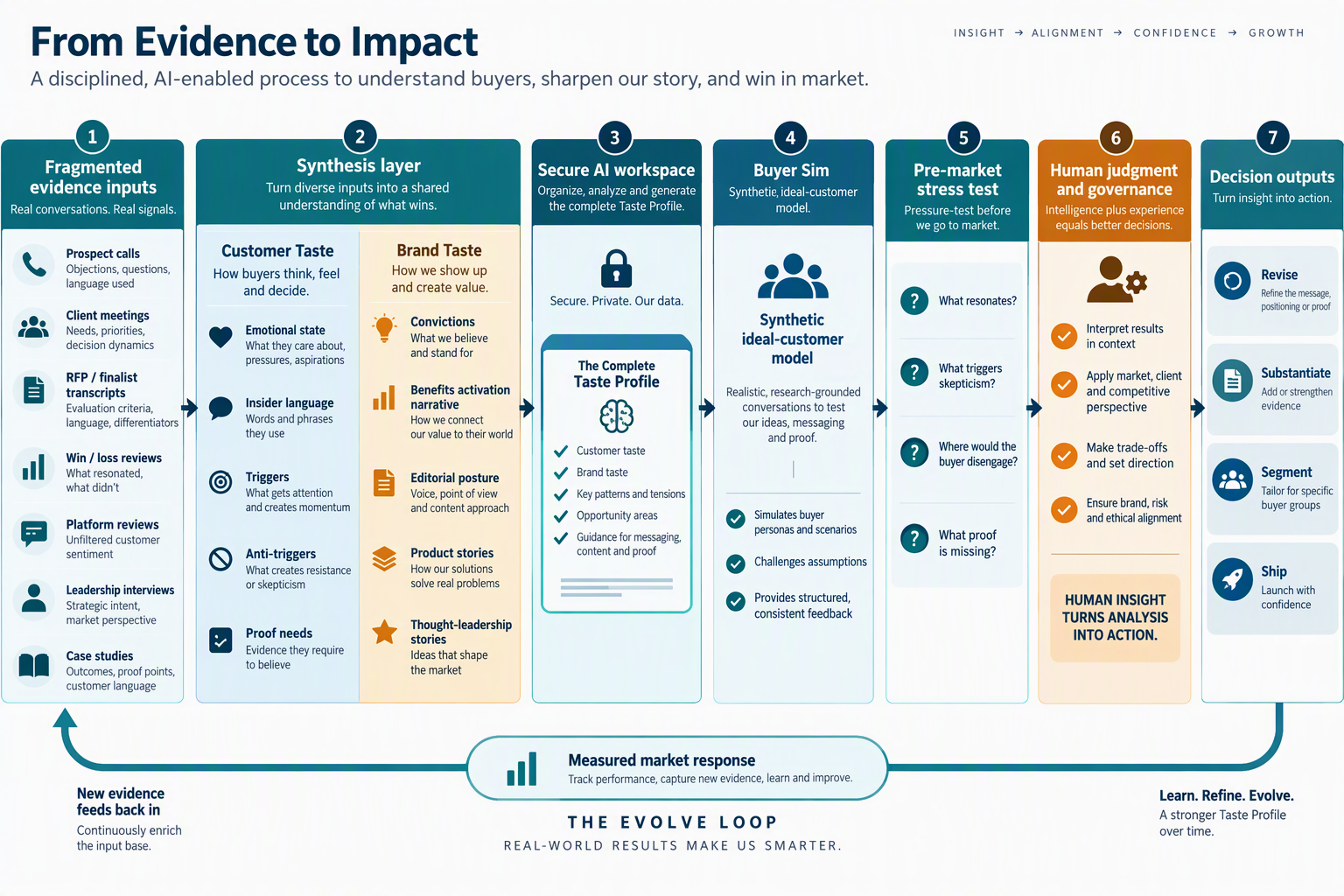
I adapted the Express stage of Loop Marketing into a practical operating layer for bswift. Loop Marketing moves through four connected stages: Express, Tailor, Amplify, and Evolve. It treats market response as intelligence that should improve the next cycle. HubSpot's framework begins with a Taste Profile, then recommends pressure-testing concepts against an ideal customer profile before committing to a direction.
I built the bswift Taste Profile in two parts.
Customer Taste: How the buyer experiences our marketing
Instead of stopping at job titles, firmographics, or surface-level pain points, I synthesized how benefits buyers actually evaluate a message:
- The emotional state they bring to the content
- The vocabulary that signals insider understanding
- The proof that reduces professional risk
- The situations in which a message becomes relevant
- The claims and tones that trigger immediate skepticism
- The peers and practitioners they trust
The verified research behind the profile includes roughly 20 platform reviews, multiple practitioner-community threads, more than half a dozen RFP semifinalist, finalist, and implementation-kickoff transcripts, broker and client interview notes, approved testimonials and case studies, an AEO buyer-query analysis, existing-client working sessions, and a strategy session with a senior benefits leader.
The synthesis revealed a buyer who is less interested in "innovation" as an abstraction than in what changes, what breaks, who owns the handoff, what the client lift will be, and what happens when the data is wrong. The practitioner is battle-tested: tired, alert to hidden labor, and skeptical of sales language, but still deeply invested in making benefits work for employees.
It also surfaced specific anti-triggers. Unsupported ROI becomes "squishy." AI without a defined task, data boundary, human review point, and exception path reads as a badge. "Seamless" without the workflow beneath it sounds like "rainbows and unicorns." For this audience, every major claim needs a mechanism and proof.
Brand Taste: What bswift believes and how it should show up
For Brand Taste, I turned extensive interviews with bswift’s C-suite leadership into a concise, reusable expression of the company’s brand, product, and thought leadership point of view. The goal was not to create another style guide. It was to capture the strategic judgment behind the brand: what bswift believes, how it sees the market, what makes its approach distinct, and where it draws the line on the claims it makes.
I condensed those conversations into three short narrative frameworks: a Brand Story that grounds the company in the human stakes behind benefits; a Product Story that explains how bswift approaches technology, service, complexity, and accountability; and a Thought Leadership Profile that defines the positions the company can credibly take on issues such as AI, personalization, engagement, and the role of technology in benefits.
Around those narratives, I built practical guardrails for how the brand should communicate. Claims had to distinguish evidence from conviction, explain the mechanism behind the promise, acknowledge meaningful limitations, and avoid the kinds of unsupported technology and ROI language our buyers were already skeptical of.
The result was a point of view that could guide very different kinds of work without exposing the underlying internal narratives themselves. You can see elements of it in bswift’s public employee engagement and activation story and in executive thought leadership such as Ted Bloomberg’s Forbes article, AI in Employee Benefits: Usefulness Is the Bar, but Trust Is the Scoreboard. The Taste Profile’s role was to turn what lived in the heads of bswift’s senior leaders into a compact strategic system that human creators and AI tools could apply consistently—even when those executives weren’t in the room.
Customer Story and Perception Gaps: the distance between what we say and what buyers believe
Brand Taste captured the story bswift wanted to tell. I also needed to understand how customers and prospects currently perceived the company—and where their existing beliefs aligned with or diverged from that intended narrative.
I analyzed selected reviews, customer references, demonstrations, prospect and customer interviews, and related material to identify the themes customers and prospects consistently emphasized. Because the evidence was qualitative and selected, I treated it as directional insight rather than representative brand tracking.
The analysis surfaced several recurring themes:
- Flexibility for complex environments
- Service and access to real people
- Integration and ecosystem fit
- Proof of the administrative foundation before personalization
- One connected experience with fewer handoffs
- Practical AI with clear controls
It also revealed areas where customers appeared to place more value than our marketing consistently reflected: the relief of knowing who owns the next step, the usefulness of controlled complexity rather than oversimplification, the operating details behind implementation and exception handling, differences in access across employee populations, and the credibility gained by clearly explaining what a capability does not do.
From there, I mapped the intended bswift story against current or legacy perceptions. For example:
- We wanted administration and activation to be understood as one connected experience, but bswift could still be perceived primarily as an enrollment and administration platform.
- We wanted AI to represent practical improvements in quality and capacity, but buyers could interpret it as a feature badge or future promise.
- We wanted an open ecosystem with accountable ownership, but integration breadth could sound like more complexity for the client to manage.
- We wanted service and scalable technology to reinforce one another, but service could be interpreted as compensation for the technology rather than part of the design.
- We wanted benefits activation to connect to business outcomes, but “engagement” could still be understood as communications activity rather than employee action.
For each gap, I identified what the content needed to clarify and what proof would be required to earn the intended narrative. That proof agenda included time-on-task and workload evidence for strategic capacity; journey-level evidence for reduced fragmentation; baseline and post-campaign action evidence for activation; workflow, error, rework, and human-review evidence for AI; service-resolution evidence; and segmented reach and action evidence for frontline strategies.
This layer was essential because the Buyer Sim needed more than a buyer profile and an internal brand narrative. It needed to understand the distance between what bswift wanted to say and what the market was currently prepared to believe.
Customer Taste captured how the buyer evaluates marketing. Brand Taste captured the company’s intended point of view. Customer Story and Perception Gaps captured existing market belief and the evidence required to move it.
Together, those layers allowed the system to test not only whether a message was relevant and on-brand, but whether it credibly closed—or accidentally widened—the gap between the two.
The Work
Once the customer and brand contexts were complete, I brought them together into a reusable source of strategic guidance. The resulting profile documented not just what the audience looks like, but how its members evaluate marketing, what earns their trust, and what makes them skeptical.
The work established a shared understanding of the buyer's expectations and a consistent way to apply that understanding to content. It also connected those expectations to bswift's brand narrative, giving marketing a way to evaluate whether a message was both relevant to the audience and consistent with what the company could credibly claim.
This created the foundation for a more consistent content workflow. Rather than reconstructing audience context for each assignment, marketing could draw on the same documented understanding of buyer language, emotional states, proof expectations, and anti-triggers.
The Buyer Sim
I loaded the Taste Profile into a secure AI workspace and configured a synthetic ideal-customer model: the Buyer Sim.
The Buyer Sim is not a generic persona chatbot. It evaluates content through the documented psychology, language, skepticism, situations, and proof expectations of bswift's target buyer. The underlying Loop model defines it as a synthetic customer built from both halves of the Taste Profile and used to evaluate marketing before it goes live.
I designed it to answer questions that ordinary copy review often misses:
- What feels immediately relevant, and why?
- Which sentence sounds like vendor language rather than buyer language?
- What claim would trigger skepticism?
- What question remains unanswered?
- What proof would make the argument credible?
- Where would this buyer stop reading, decline to share, or refuse the next step?
That created a new pre-market decision gate. A campaign concept, executive byline, blog draft, messaging matrix, or landing page could be tested before the team committed production and distribution resources.
The operating model
The critical layer is human judgment and governance. The Buyer Sim does not approve work or replace customer research. It exposes likely weaknesses so a strategist can revise, substantiate, segment, or proceed with greater confidence.
That distinction matters. Research on synthetic personas warns that representativeness and ecological validity vary widely. Stronger systems define the task and population clearly, ground the persona in empirical data, and acknowledge limitations. Qualtrics similarly positions synthetic research as most useful for early exploration and concept testing, not as a replacement for human validation in high-stakes decisions.
In other words, I treated the Buyer Sim as a falsification tool, not an oracle.
The Results
The strongest documented before-and-after is a workflow transformation rather than a campaign-performance claim.
Before
-
Buyer knowledge was distributed across calls, documents, systems, and individual memory.
-
Audience context had to be reconstructed for each assignment.
-
Narrative consistency depended on manual review.
-
AI outputs began with incomplete context.
-
Objections and gaps in resonance often surfaced during stakeholder review or after launch.
After
-
Customer and brand judgment lived in one reusable source of truth.
-
Buyer language, emotional states, proof expectations, and anti-triggers could be applied consistently.
-
The benefits activation narrative could guide work across formats.
-
AI-assisted production could begin with governed context rather than a generic prompt.
-
Priority assets could pass through a repeatable pre-market stress test.
This also established the foundation for a broader Loop Marketing transition. The internal operating model calls for buyer signals to become intelligence, intelligence to shape marketing, and market response to generate new intelligence. The Taste Profile and Buyer Sim make that cycle actionable at the point where messaging decisions occur.
The clearest achieved outcome is that I built and documented a substantial, reusable audience-intelligence system, not merely a messaging playbook.
The completed profile distinguishes practitioners, senior HR leaders, and broker and consultant shortlist shapers by their pressures, language, proof requirements, decision horizons, and emotional payoff. It also contains explicit evidence limitations, including the warning that the research corpus is qualitative and selected, and is not suitable for unsupported claims about how prevalent a particular view is among all buyers.
The work created:
- A documented understanding of the audience
- An operational vocabulary and set of anti-triggers
- A connected category narrative
- A pre-publication quality gate
- A reusable context layer for human and AI-supported work
- A foundation for continuous customer-learning workflows
What I cannot yet substantiate is equally important. Broader adoption beyond the Taste Profile's creation has not been documented. I therefore would not claim that the system has already reduced revision time, increased conversion, improved campaign engagement, or become broadly adopted across Marketing.
Why This Work Matters
This project changed the level at which I was operating.
I was no longer only producing content. I was designing the system that determines what good content should say, what evidence it needs, how it should be tested, and how the organization can learn from it.
The work demonstrates four connected capabilities:
- Research synthesis: Turning fragmented qualitative evidence into a usable model of buyer judgment.
- Strategic narrative design: Connecting administration, activation, AI, engagement, and outcomes into one defensible story.
- AI workflow design: Embedding documented buyer and brand context into a repeatable pre-market testing process.
- Operational innovation: Converting individual knowledge into a reusable process that can improve work across campaigns and formats.
The result is a marketing decision engine: one that helps bswift bring the buyer into the room before the work reaches the market.
.