Brand Strategy & Category Development Case Study:
Building the Benefits Activation Narrative and the System to Own It
bswift had capabilities extending well beyond benefits administration, but its market story didn't fully connect those capabilities or explain the broader value they created. I developed a narrative positioning benefits administration as the foundation and benefits activation as the outcome it makes possible. I then extended that narrative into a 2027 category strategy, designing a measurement framework, evidence engine, publishing program, and buyer tools to help bswift establish authority around benefits activation.
The Issue
Benefits administration is essential, but it is increasingly difficult to differentiate on administration alone.
The category conversation tends to center on features, service models, integrations, enrollment, and operational reliability. Those things matter enormously to HR teams. But they do not fully explain the value created when a benefits program actually works for the people it is designed to serve.
At the same time, bswift had capabilities extending well beyond enrollment and administration: decision support, AI-enabled guidance, personalization, communication, engagement, and ongoing benefits navigation.
The strategic problem was how to connect those capabilities without turning them into a collection of disconnected product stories, or implying that administration itself was somehow outdated.
I saw an opportunity to change the frame.
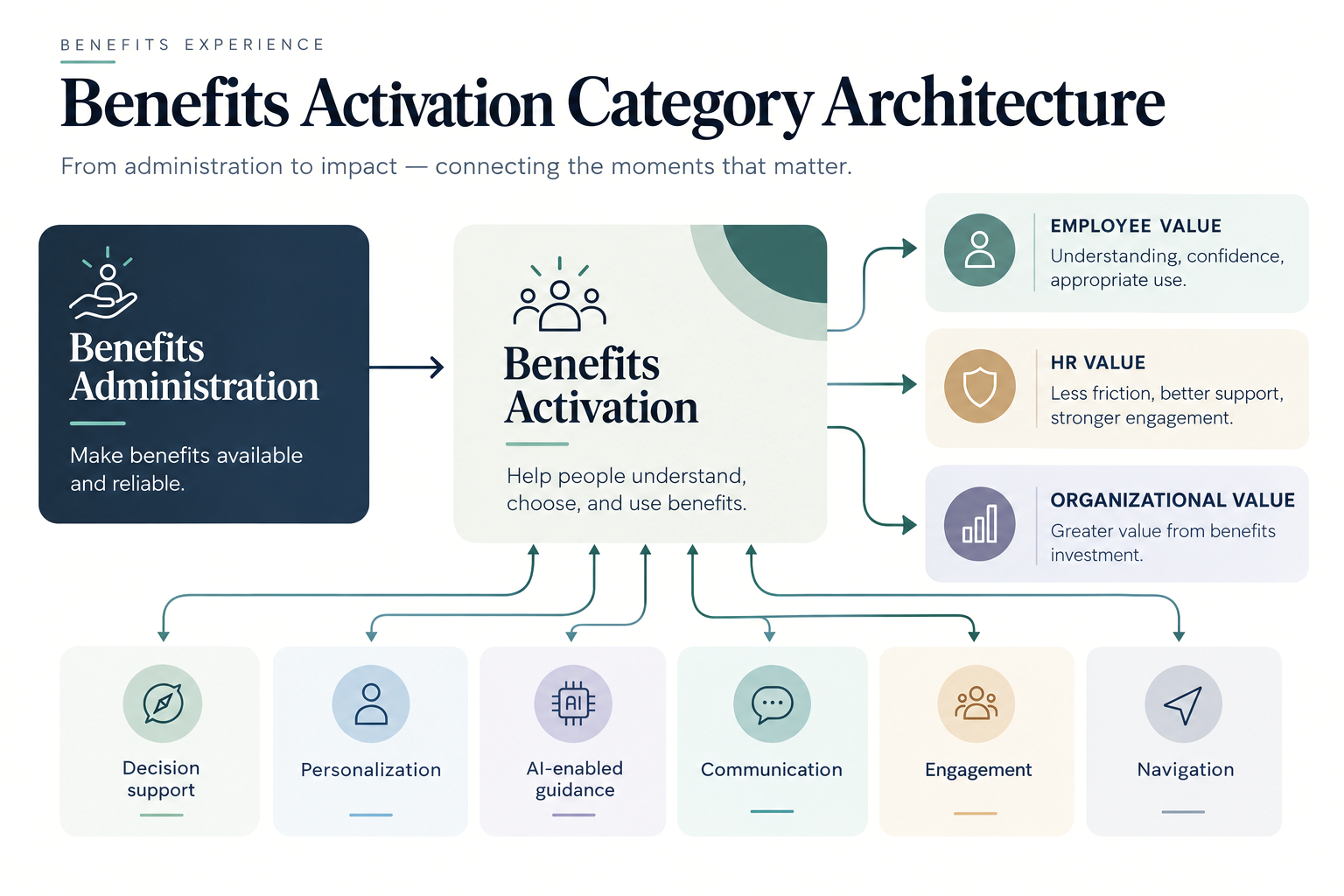
Instead of positioning administration and engagement as competing ideas, I developed a narrative in which administration is the foundation and activation is the outcome it makes possible.
Benefits administration makes benefits available. Benefits activation helps people understand, choose, and use them.
That distinction became the foundation for a broader category strategy.
The Plan
The idea behind benefits activation was not that employers needed another HR technology category.
It was that employers already invest heavily in benefits, administration, communication, navigation, and point solutions, but employees still struggle to understand what they have, make confident decisions, and use those benefits when they need them.
That created a more useful strategic question:
What happens between offering a benefit and realizing its value?
I began organizing the bswift story around that gap.
Administration creates the infrastructure: eligibility, enrollment, data accuracy, integrations, compliance, and reliable execution.
Activation builds on that infrastructure through:
- Decision support
- Personalized guidance
- Relevant communication
- Timely engagement
- Benefits navigation
- Ongoing support
The result was a causal story rather than a product hierarchy:
Reliable administration → better understanding → more confident decisions → appropriate benefits use → stronger employee and organizational outcomes.
This also gave bswift a way to talk about its broader portfolio without forcing every capability into a separate messaging pillar.
The Work
A category idea only matters if people can actually use it.
I began translating benefits activation into market-facing work rather than leaving it inside a positioning document.
The narrative appeared across multiple formats and audiences, including:
- Benefits Beat
- Post–Idea Exchange content
- Personalization and activation thought leadership
- Executive content
- The SVEF presentation
- Product- and Sales-adjacent messaging
One documented example came from the SVEF personalization presentation.
Rather than treating personalization as the entire story, I proposed reframing the presentation around benefits activation while preserving personalization as the mechanism that makes activation possible.
The change was accepted and incorporated into the presentation.
That distinction mattered strategically. It allowed individual capabilities such as personalization, AI, engagement, and decision support to reinforce a larger bswift point of view instead of competing for attention as isolated features.
Internal feedback also validated the architecture: leadership specifically responded positively to the clearer connection between Engagement Solutions and Evive within the broader activation story.
The narrative was becoming usable and adopted internally. But we needed to make it sticky.
That's why the next question was harder: How do you turn a compelling narrative into something the market can reliably recognize, measure, and eventually associate with your company?
The Category Strategy
For the 2026 strategy, I moved from messaging architecture into category architecture.
I developed a system designed to make benefits activation more than a phrase.
At its center was the benefits activation gap: the distance between making benefits available and employees actually understanding, choosing, and using them effectively.
Making that gap visible and real for employers gives them a clearer picture of the value employees are leaving on the table—and where better guidance, communication, and support can help close it. For employers, that gap represents unrealized value: benefits they are already paying for but that may not improve employee outcomes, support retention, or help control costs if employees do not know when and how to use them.
From there, I designed a measurement and authority framework around several connected components.
A six-stage activation measurement model
Rather than treating engagement as a single metric, the framework was designed to examine activation across a progression of behaviors.
The goal was to give bswift a more disciplined way to connect employee behavior with the outcomes employers ultimately care about.
Signals by Evive: Our Benefits Behavior Lab
I proposed an evidence engine we ended up calling Signals by Evive that could turn proprietary data, customer research, behavioral patterns, and market observations into recurring insight.
Instead of publishing isolated statistics, Signals would create a repeatable source of evidence behind the category, including research on personalized benefits engagement and how sustained engagement creates value over time.
Regular authority assets
That is the difference between developing messaging and building the infrastructure for category ownership.
The strategy connected research to a publishing cadence so category ownership would be built through repeated proof rather than a one-time campaign.
This included an immersive pop-up experience to make benefits activation a hands-on education moment at bswift's annual conference, Idea Exchange. You can see a video walk through here: What Benefits Leaders Saw at Idea Exchange Changed How They Think About Benefits Engagement.
That authority work showed up in bswift's blog, our regular Benefits Beat LinkedIn newsletter, and extended into executive thought leadership, as well, including bswift CEO Ted Bloomberg’s Forbes articles on AI, usefulness, and trust in employee benefits and the role employee decisions play in rising healthcare costs.
Buyer tools
The framework also moved beyond thought leadership into practical diagnostics and tools buyers could use to evaluate their own activation challenges, including resources for evaluating benefits administration software and the Benefits Administration Buyer’s Guide.
That was important because a category becomes more useful when customers can apply it to their own organization.
Evidence and validation standards
Most importantly, I built explicit guardrails around what bswift could and could not claim.
A central tension was that benefits activation describes the value of the broader bswift experience, while much of the strongest available outcome evidence currently comes from Evive populations.
There were two easy but strategically weak solutions:
- Shrink benefits activation until it effectively means Evive.
- Stretch Evive evidence across the entire bswift portfolio.
I rejected both.
Instead, the strategy separated the category architecture from the scope of individual evidence, requiring clear population definitions, validation gates, and disclosure of what each proof point actually demonstrates.
That made evidence governance part of the category strategy itself.
The Operating Model
The resulting system connected narrative, evidence, measurement, and market activation:
Market problem → Benefits Activation framework → proprietary evidence → authority content → buyer tools → market response → stronger evidence
The objective was not simply to publish more content about benefits activation.
It was to create a system in which every research cycle, customer conversation, campaign, and proof point could make the category more useful and more defensible.
The Results
The strongest achieved outcome so far is narrative adoption and operationalization, not market category ownership.
The benefits activation framing moved beyond strategy work into multiple market-facing formats and helped create a more cohesive way to connect administration, Engagement Solutions, Evive, personalization, AI, and employee outcomes.
The enterprise record also documents positive leadership response to the clearer connection between previously separate parts of the portfolio.
The 2026 work then extended that narrative into a substantially more developed system containing:
- A defined activation problem
- A measurement architecture
- An evidence engine
- Quarterly authority assets
- Buyer diagnostics
- Evidence standards
- Validation gates
- Explicit success signals for future category adoption
What I cannot yet claim is equally important.
The system was designed, not fully implemented during this period. I therefore would not claim that bswift already owns the benefits activation category, but we have seen competitors trying to reframe their work in similar ways since we launched this project, and at least a few smaller companies outright adopt the "benefits activation" phrase despite not having the evidence to back it up.
Why This Work Matters
This project began as a messaging challenge and became a category-design problem.
I was not simply finding a better way to describe bswift.
I was designing the connective tissue between:
- Product capabilities
- Customer problems
- Brand positioning
- Thought leadership
- Proprietary evidence
- Measurement
- Sales conversations
- Market authority
The progression is what makes the work significant.
First, I made the story usable. Then I designed the system required to prove it.
That is the difference between developing messaging and building the infrastructure for category ownership.